Since the dawn of social media, it has been hailed as a unifying and liberating force in the world. While the “Facebook Revolution” in Egypt showed the world how mass personal connection provided through social media is powerful enough to overthrow a corrupt government, the 2016 U.S. presidential election showed how dangerous social media can become when hostile governments use it to influence an election.
Influencing public opinion is nothing new, it’s called propaganda and has been proven effective throughout time. During World War II, British propaganda convinced the world that Royal Air Force pilots had better eyesight because they ate carrots, not because they were using Airborne Interception Radar (AI) on their planes to hit German targets at night. So why is this new wave of social media propaganda being heralded as a great threat to national security? I don’t believe propaganda is a new threat; I believe the new threat is the volume of propaganda we are bombarded with all day under the guise of “news.”
Signal-to-noise ratio is a concept you are probably only familiar with if you have an engineering background (or you have a sibling who bores you at dinner by talking about engineering). Basically, it communicates how easy it is to differentiate the signal you are trying to measure from the background noise (don’t worry this isn’t going to turn into a engineering paper). I just want to use signal-to-noise as a concept to communicate how the volume of “news” we receive each day can be dangerous.
-Now for a quick aside-
If you were wondering why on earth I chose a picture of a palace for an essay about social media and news, I have two reasons. (1) I wanted a picture that resembled a graph with an intensity peak because my engineering brain couldn’t resist drawing the parallel. If you can’t see the graph, draw a line along the horizon and place that picture along an X-Y axis with Y being intensity. If you still can’t see the graph, then this might be evidence that my Ph.D. is getting to me. (2) I love the picture! I had such a great trip to Portugal with my mom and sister and wanted to share the memory!
-OK back to the point-
In this first picture of the Palácio da Pena in Sintra, Portugal, it is very easy to see the palace. Not only does its red and yellow coloring differentiate it from the surrounding green hills, it also resides on the peak of the hill.
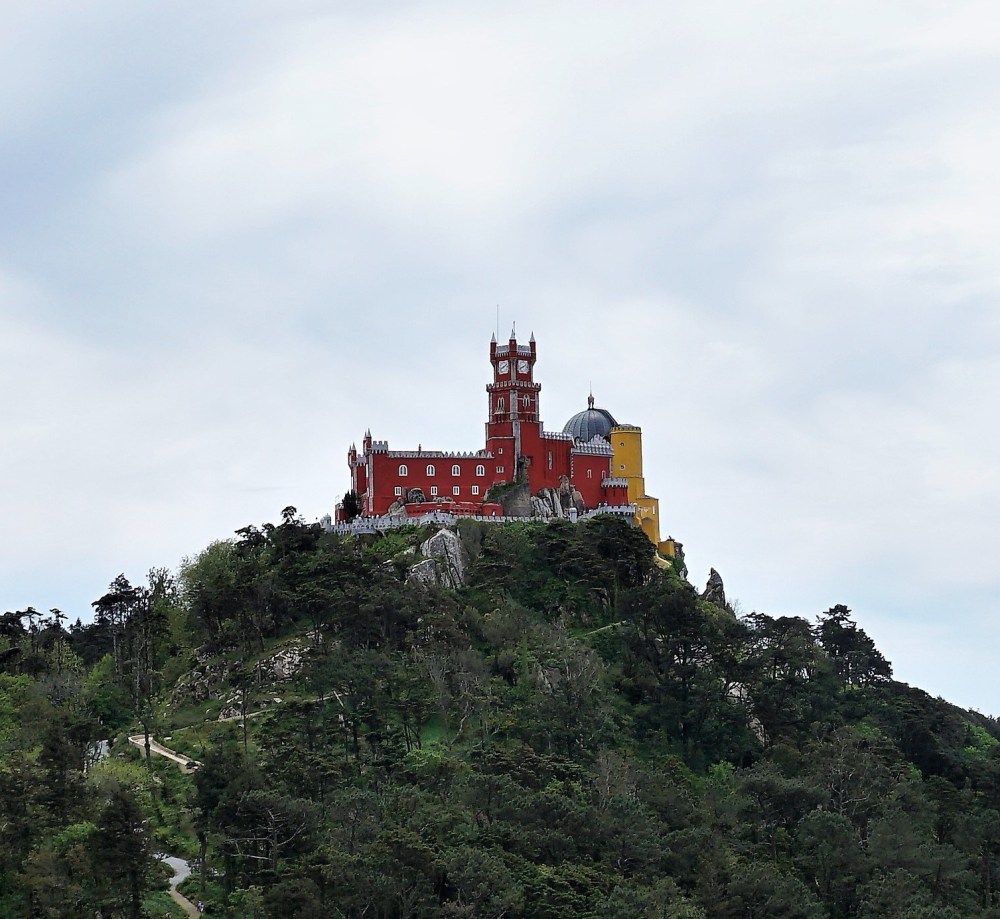
If we now widen the field of view of this image to include more of the surrounding green hills, it becomes more difficult to differentiate the palace from the hills because there is more “noise”. If the palace is the signal and the hills are the noise, the signal-to-noise ratio of this image massively decreased from the first image. When dealing with data, this means that the signal is less statistically significant — harder to find and therefore harder to trust.

By allowing unregulated social media to provide our news, we are widening our field of view to the point where we have a more difficult time differentiating true news from propaganda, especially if the propaganda aligns with our values and point of view. In engineering, that is called confirmation bias. Confirmation bias is when we find evidence to fit our theories instead of allowing evidence to create theories. In terms of the news, if an average news consumer sees 50 articles that align with their experience from non-reputable sites and 5 articles that don’t align as closely with their experience but are from reputable news sources, they are less likely to believe the 5 articles because they have evidence in those 50 non-reputable articles that supports their theories. This poses a greater threat to truth than propaganda. It also has a two fold effect. Not only does it allow confirmation bias, it also causes us to trust the true signal less.
That isn’t where the threat to fact based news ends. President Trump has exasperated this threat by calling any negative news about himself “alternative facts.” There is no such thing as “alternative facts.” It is inherently an oxymoron. Facts are irrefutable. Period. That’s what makes them facts. A common misconception of science and engineering is we deal with facts. We deal with evidence based theories. Most people believe gravity is a fact; it is really just a theory that all measured evidence supports and therefore it is generally accepted as true. However, if physicists discover evidence to contradict gravity tomorrow, the theory would be called into question. I would be more comfortable if all news used the word “fact” less casually. When journalists and politicians call theories and opinions facts, they devalue true facts. The purpose of the news is to distill and present the source materials in a comprehensible manner. By bringing these three different types of information into the same plane, the consumer isn’t able to digest and evaluate the information independently. To illustrate this visually, I made the Palácio da Pena and hills grey-scale. Upon first glance, you may not notice the palace among the hills, and even once you do, you know nothing other than its shape. By stripping away the color, you remove defining information about the palace that allow you to form your own opinion.

I understand some politicians and journalists live and die based on public opinion. Perception is more valuable than reality. This is probably a contributing factor to misusing “facts.” They cannot seem like they are uninformed or non-omniscient. They cannot shake the faith their constituents have in them. They believe that is how they lose re-election. But at what cost. Overuse of hyperbole devalues the meaning of the word in the hyperbole. Devaluation of these words is the final nail in the coffin. The noise will overcome the signal and we won’t be able to differentiate the palace from the hills.
I am not suggesting social media is evil. I think it is a key element of our freedom of speech and it has the power to do a great deal of good. It has provided a platform for grass roots movements such as “March for our Lives” that are bringing important issues to the forefront of public debate and are trying to shape our society for the better. And I understand the irony of posting on the internet and promoting through social media an essay analyzing the role of social media in our decaying perception of news. However, we need to discuss safeguards to allow social media to do what is was made for without undermining the integrity of our news. We need to boost the signal. We need to make truth the center of our politics. We need news that communicates the true facts and then people can form opinions to the right or left of those facts.
Facebook’s CEO and Founder Mark Zuckerberg appeared before the Senate Commerce, Science and Transportation Committee to testify about Facebook’s data protection lapses and their role in the misinformation campaigns conducted throughout the 2016 presidential campaign. While Zuckerberg promises to improve protections of Facebook users’ personal data, little is being said about protecting their consumers from malicious falsities masquerading as news. The damage caused by misinformation campaigns expand beyond the border of the United States. Misinformation campaigns conducted through Facebook have been linked to the amplification of religious tensions in several countries. For example, in Sri Lanka the death of a Buddhist man due to a traffic dispute escalated and morphed into a nefarious Muslim plot to wipe out the Buddhist population of Sri Lanka. The impact of misinformation is especially concerning in developing countries that may not have reputable news organizations for people to look at for confirmation or contradiction of what they see on Facebook or other social media sites.
Social media is meant to amplify the common man’s voice. However, without regulation, a few clever, malicious voices can bring a society to its knees. Social media already implements checks to ensure people aren’t impersonating public figures. The blue check following the name’s of public figures doesn’t prevent fake accounts from being created; they simply allow other users to understand if the account is verified as the public figure. We need to do something similar with news stories and accounts. If social media sites can establish a system of scoring the accuracy of different accounts that claim to be reporting the news, other users would be able to understand the trustworthiness of the posts from that account. The score would simply reflect the accuracy of the facts in the article, not offer an opinion. This would amplify fact-based reporting without stripping anyone of their freedom of speech. We just need to make it a little easier for people to understand what they are reading so they can develop educated opinions.
 Hardy Girl